Ideal Weight Calculator
This ideal weight calculator shows the healthy weight range for your height (BMI 18.5 to 24.9) and what three classic "ideal weight" formulas say, side by side.
Sources: CDC, WHO Updated
Healthy weight range for 5 ft 9 in (BMI 18.5 to 24.9)
125–168 lb
| Formula | Men | Calculation |
|---|---|---|
| Devine (1974) | 156 lb | 50 kg + 2.3 kg × 9 in |
| Robinson (1983) | 152 lb | 52 kg + 1.9 kg × 9 in |
| Hamwi (1964) | 160 lb | 106 lb + 6 lb × 9 in |
The formulas give one number each and ignore age, build and muscle. The BMI range is the better guide to what is healthy.
The numbers above are an example. Change them to see your own result.
A shared link contains the numbers entered here.
For adults aged 20 and over. The figures are reference points, not a goal anyone has to reach.
Ideal weight for your height: a range or a single number
A range from BMI. For adults, a BMI of 18.5 to 24.9 is the healthy weight range used by WHO, CDC and the NIH. This is the answer health agencies give, and the one the calculator shows first.
For any height that range is a span of weights: 30 pounds wide at 4 feet 10 inches and 50 pounds wide at 6 feet 2 inches. The BMI chart shows where your own weight falls, and the reverse BMI calculator gives the weight for any BMI.
A single number from a formula. The "ideal body weight" formulas were written for other purposes, such as working out medicine doses, and became popular as weight targets. Each takes a starting weight at 5 feet and adds a fixed amount for every inch above it.
Ideal body weight formulas: Devine, Robinson and Hamwi
| Formula | Men | Women |
|---|---|---|
| Devine (1974) | 50 kg + 2.3 kg per inch over 5 ft | 45.5 kg + 2.3 kg per inch over 5 ft |
| Robinson (1983) | 52 kg + 1.9 kg per inch over 5 ft | 49 kg + 1.7 kg per inch over 5 ft |
| Hamwi (1964) | 106 lb + 6 lb per inch over 5 ft | 100 lb + 5 lb per inch over 5 ft |
The equations are given as printed in a 2021 commentary in Clinical Nutrition ESPEN.
How to calculate ideal weight: a worked example
A woman who is 5 feet 4 inches tall is 4 inches over 5 feet.
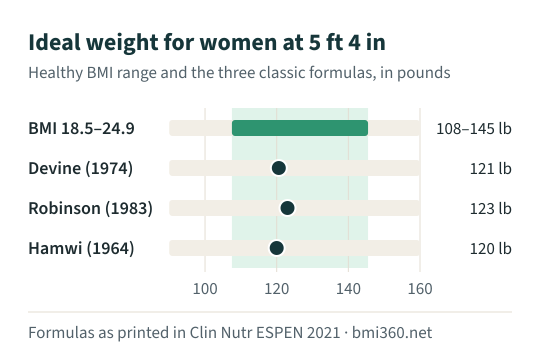
- Devine: 45.5 + 2.3 × 4 = 54.7 kg (121 lb).
- Robinson: 49 + 1.7 × 4 = 55.8 kg (123 lb).
- Hamwi: 100 + 5 × 4 = 120 lb (54.4 kg).
- Healthy range from BMI 18.5 to 24.9 at 64 inches: 108–145 lb.
All three formula results sit inside the BMI range, in its lower half. The range is the more honest answer: it shows how many different weights are compatible with a healthy BMI at one height.
To see where your own weight falls, enter it in the BMI calculator.
Healthy weight range by height chart
| Height | In cm | Healthy weight (lb) | Healthy weight (kg) |
|---|---|---|---|
| 4′ 10″ | 147 cm | 89–119 lb | 40.1–54.1 kg |
| 4′ 11″ | 150 cm | 92–123 lb | 41.5–56.0 kg |
| 5′ 0″ | 152 cm | 95–127 lb | 42.9–57.9 kg |
| 5′ 1″ | 155 cm | 98–132 lb | 44.3–59.8 kg |
| 5′ 2″ | 157 cm | 101–136 lb | 45.8–61.8 kg |
| 5′ 3″ | 160 cm | 105–140 lb | 47.3–63.8 kg |
| 5′ 4″ | 163 cm | 108–145 lb | 48.8–65.9 kg |
| 5′ 5″ | 165 cm | 111–149 lb | 50.3–68.0 kg |
| 5′ 6″ | 168 cm | 115–154 lb | 51.9–70.1 kg |
| 5′ 7″ | 170 cm | 118–159 lb | 53.5–72.2 kg |
| 5′ 8″ | 173 cm | 122–164 lb | 55.1–74.4 kg |
| 5′ 9″ | 175 cm | 125–168 lb | 56.7–76.6 kg |
| 5′ 10″ | 178 cm | 129–173 lb | 58.4–78.8 kg |
| 5′ 11″ | 180 cm | 133–178 lb | 60.1–81.1 kg |
| 6′ 0″ | 183 cm | 137–183 lb | 61.8–83.4 kg |
| 6′ 1″ | 185 cm | 140–189 lb | 63.5–85.7 kg |
| 6′ 2″ | 188 cm | 144–194 lb | 65.2–88.1 kg |
| 6′ 3″ | 191 cm | 148–199 lb | 67.0–90.5 kg |
| 6′ 4″ | 193 cm | 152–204 lb | 68.8–92.9 kg |
| 6′ 5″ | 196 cm | 156–210 lb | 70.6–95.4 kg |
| 6′ 6″ | 198 cm | 160–215 lb | 72.5–97.9 kg |
What ideal weight numbers cannot tell you
- They ignore build and muscle. Height is the only input. Two people of the same height can be healthy at quite different weights. A waist-to-height ratio adds a measurement of where weight sits.
- The formulas assume weight rises in a straight line with height. The commentary we cite points out that they do not produce consistent BMIs across heights.
- They are not defined below 5 feet, and they were not made for children or teenagers.
- They are not a diagnosis or a prescription. If you are thinking about changing your weight, a doctor or registered dietitian can help you set a goal that fits you.
Questions about ideal weight
What is my ideal weight?
There is no single ideal weight for a height. The best supported answer is a range: the weights that give a BMI of 18.5 to 24.9, which health agencies call the healthy weight range for adults. The formulas on this page each give one number inside or near that range.
What is a healthy weight for my height and age?
For adults the answer does not change with age: CDC applies the healthy BMI range of 18.5 to 24.9 to everyone aged 20 and over, whatever their age or sex, and the Devine, Robinson and Hamwi formulas do not use age either. The UK's NICE guideline advises reading BMI with caution in people aged 65 and over. For children and teens, weight for height is read as a BMI-for-age percentile in the kids BMI calculator.
What do the formulas give for an average height?
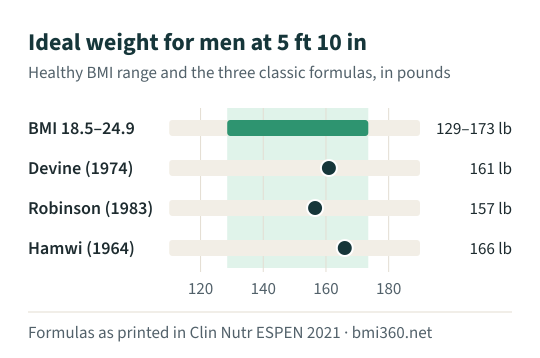
For a man of 5 ft 10 in: Devine 161 lb, Robinson 157 lb, Hamwi 166 lb; the healthy BMI range is 129–173 lb. For a woman of 5 ft 4 in: Devine 121 lb, Robinson 123 lb, Hamwi 120 lb; the healthy BMI range is 108–145 lb.
Why do the formulas give different answers?
Each adds a fixed amount per inch of height above 5 feet, with slightly different starting points and steps. They were derived from height and weight tables, and a review of their history concluded that they agree as far as those tables agree. None of them was built to say what is healthy for one person.
Why is the formula result different for women and men?
The formulas have separate equations for each sex, with a lower starting weight for women. The BMI range is the same for both.
Do the formulas work for people shorter than 5 feet?
No. They count inches over 5 feet, so they are not defined below that height. The calculator then shows only the BMI range.
Sources
- CDC: Adult BMI categories — category names and ranges for adults 20 and older, including obesity classes (checked October 12, 2026)
- Chichester S, Holmes TM, Hubbard J. Ideal body weight: a commentary. Clin Nutr ESPEN. 2021;46:246-250 — the Devine, Robinson and Hamwi equations (Table 1) and their limits (checked October 12, 2026)
- Pai MP, Paloucek FP. The origin of the "ideal" body weight equations. Ann Pharmacother. 2000;34(9):1066-9 — where the equations come from and why they agree with each other (checked October 12, 2026)
- WHO: Obesity and overweight (fact sheet) — BMI definition; adult overweight is a BMI of 25 or more, obesity 30 or more (checked October 12, 2026)
- NICE guideline NG246: Identifying and assessing overweight, obesity and central adiposity — waist-to-height bands, lower BMI thresholds for some ethnic backgrounds, caution with BMI in older and muscular adults (checked October 12, 2026)