BMI Calculator
This BMI calculator gives your body mass index, its category and the healthy weight range for your height. A healthy BMI for adults is 18.5 to 24.9.
Sources: WHO, CDC, NIH Updated
Your BMI
23.6
Healthy weight BMI 18.5 to 24.9
Healthy weight for your height: 125–168 lb
Your weight is within this range. A BMI of 18.5 to 24.9 is in the healthy weight range for adults.
The numbers above are an example. Change them to see your own result.
A shared link contains the numbers entered here.
For adults aged 20 and over. For ages 2 to 19 use the kids BMI calculator, which compares the BMI with other children of the same age and sex.
BMI formula: how BMI is calculated
Body mass index is your weight divided by the square of your height. CDC publishes the formula in metric and in U.S. units:
BMI = weight (kg) ÷ height (m)²
BMI = 703 × weight (lb) ÷ height (in)²
The calculator rounds the result to one decimal and reads the category from that rounded number, so the figure you see and its label always match.
How to calculate BMI by hand: a worked example
A person who is 5 feet 9 inches tall and weighs 160 pounds:
- Height in inches: 5 × 12 + 9 = 69 in.
- Height squared: 69 × 69 = 4,761.
- 703 × 160 = 112,480.
- 112,480 ÷ 4,761 = 23.63, which rounds to a BMI of 23.6: healthy weight.
- Healthy weight at this height (BMI 18.5 to 24.9): 125–168 lb.
In metric units, 72.5 kg at 175 cm is 72.5 ÷ (1.75 × 1.75) = 23.67, a BMI of 23.7. Need to convert first? Use the pounds to kilograms converter on UnitCheck.
To work the other way, from a BMI to a weight, use the reverse BMI calculator.
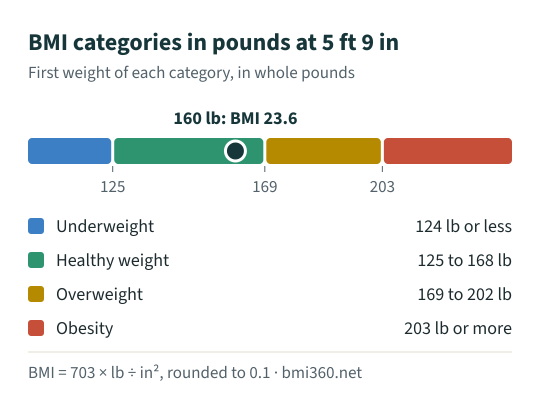
BMI categories for adults
| Category | BMI | Weight at 5′ 9″ |
|---|---|---|
| Underweight | below 18.5 | 124 lb or less |
| Healthy weight | 18.5 to 24.9 | 125 to 168 lb |
| Overweight | 25.0 to 29.9 | 169 to 202 lb |
| Obesity | 30.0 or above | 203 lb or more |
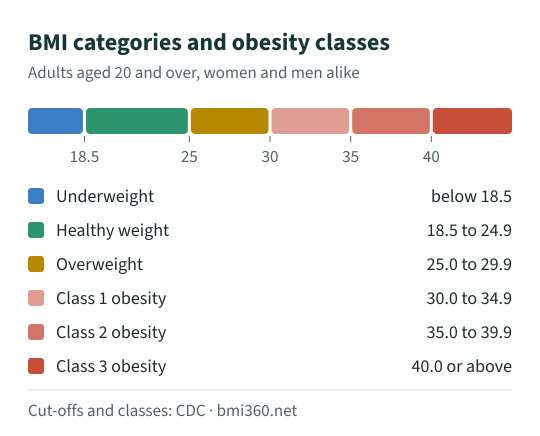
These are the cut-offs published by the World Health Organization, the U.S. Centers for Disease Control and Prevention (CDC) and the National Heart, Lung, and Blood Institute. CDC divides obesity into three classes: class 1 is a BMI of 30.0 to 34.9, class 2 is 35.0 to 39.9 and class 3 is 40.0 or above.
The BMI chart shows every height and weight in one table. The ideal weight calculator puts the healthy weight range next to the classic single-number formulas.
What BMI does not measure
BMI is quick and needs only a scale and a tape measure. That is also its limit. CDC describes it as a screening measure: one indicator to be looked at together with others.
- It cannot tell fat from muscle and bone. A muscular person can have a BMI in the overweight or obesity range without excess body fat.
- It does not show where fat sits. NICE recommends the waist-to-height ratio to estimate fat around the waist, which is linked to type 2 diabetes, high blood pressure and cardiovascular disease.
- It needs care in older adults. The UK's NICE guideline says to interpret BMI with caution in people aged 65 and over, and notes that a slightly higher BMI may be protective at that age.
- One set of cut-offs does not fit every background equally. NICE uses lower thresholds (23 for overweight, 27.5 for obesity) for people with a South Asian, Chinese, other Asian, Middle Eastern, Black African or African-Caribbean background.
- It is not a diagnosis. CDC says BMI should be considered with other factors when assessing a person's health.
If your result surprises or worries you, that is a good reason to talk to a doctor or a registered dietitian, not a reason for alarm.
Questions about BMI
What is a healthy BMI?
For adults aged 20 and over, a BMI from 18.5 to 24.9 is in the healthy weight range. Below 18.5 is underweight, 25.0 to 29.9 is overweight and 30.0 or above is obesity. WHO, CDC and the U.S. National Institutes of Health all use these cut-offs.
Is BMI calculated differently for women and men?
No. The formula and the categories are the same. CDC states that for adults 20 and older the categories apply regardless of age, sex or race. BMI is calculated from height and weight only, so it is a screening measure and not a measurement of body fat.
Does the BMI calculator take age into account?
Not for adults: CDC applies the same categories to everyone aged 20 and over, whatever their age or sex, so the calculator does not ask for it. For ages 2 to 19, age and sex decide the category, which is why children need a separate calculator. The UK's NICE guideline advises reading BMI with caution in people aged 65 and over.
How do I calculate BMI by hand with pounds and inches?
Multiply your weight in pounds by 703, then divide by your height in inches twice. CDC's own example: 5 feet 8 inches (68 inches) and 200 pounds gives 703 × 200 ÷ 68 ÷ 68 = 30.4.
Is BMI accurate if I have a lot of muscle?
Less so. BMI cannot tell fat from muscle and bone, so a muscular person can land in the overweight or obesity range without carrying excess fat. A waist-to-height ratio adds information about where weight sits.
Can I use this calculator for a teenager?
Not for the category. The number is calculated the same way, but for ages 2 to 19 it is compared with other children of the same age and sex. Use the kids BMI calculator, which gives a percentile.
Are the cut-offs the same for every ethnic background?
CDC and the NIH use one set of cut-offs for all adults. The UK's NICE guideline advises lower thresholds for people with a South Asian, Chinese, other Asian, Middle Eastern, Black African or African-Caribbean background: overweight from a BMI of 23 and obesity from 27.5, because health risks appear at a lower BMI in these groups.
Sources
- WHO: Obesity and overweight (fact sheet) — BMI definition; adult overweight is a BMI of 25 or more, obesity 30 or more (checked October 12, 2026)
- CDC: Adult BMI categories — category names and ranges for adults 20 and older, including obesity classes (checked October 12, 2026)
- NHLBI (National Institutes of Health): Calculate your BMI — the same four adult categories (checked October 12, 2026)
- CDC: BMI frequently asked questions — the formula in metric and U.S. units, and what BMI cannot show (checked October 12, 2026)
- WHO Nutrition Landscape Information System: BMI cut-offs for adults — underweight below 18.5, normal weight 18.5 to 24.9 (checked October 12, 2026)
- NICE guideline NG246: Identifying and assessing overweight, obesity and central adiposity — waist-to-height bands, lower BMI thresholds for some ethnic backgrounds, caution with BMI in older and muscular adults (checked October 12, 2026)