Body Fat Calculator
This body fat calculator estimates your body fat percentage from height, neck and waist (women also enter hips) with the U.S. Navy tape equations. Their reported error is 3 to 4 percentage points.
Sources: Foulis et al. 2023 Updated
Estimated body fat
17%
- Typical error of the equations3 to 4 percentage points
- Waist − neck18.5 in
- Unrounded result16.5%
An estimate from tape measurements, not a measurement of body fat. In a study of Army recruits this method read about 6 percentage points lower than a DXA scan on average.
The numbers above are an example. Change them to see your own result.
A shared link contains the numbers entered here.
For adults. This is an estimate from three or four tape measurements. It is not a measurement of body fat and not a diagnosis.
Navy body fat formula for men and women
The calculator uses the circumference equations the U.S. Navy developed in 1984. They take the difference between the waist (for women, waist plus hips) and the neck, and set it against height. All lengths are in inches; "log" is the logarithm to base 10.
men: 86.010 × log(abdomen − neck) − 70.041 × log(height) + 36.76
women: 163.205 × log(waist + hips − neck) − 97.684 × log(height) − 78.387
Centimetres are converted to inches first. The result is rounded to a whole percent, because the method is not precise enough for decimals.
Where to measure neck, waist and hips
- Neck: around the neck, tape flat on the skin.
- Men, waist: around the abdomen at the level of the navel.
- Women, waist: at the narrowest part of the torso.
- Women, hips: at the widest part of the buttocks.
- Height: without shoes.
Keep the tape level and flat on the skin without pressing in. If you can, let someone else hold the tape: military tape measurements are taken by a two-person team for that reason.
How to calculate body fat with the Navy formula: a worked example
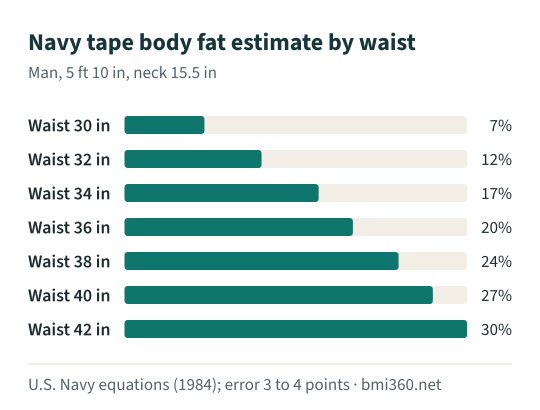
A man who is 5 feet 10 inches tall, with a 15.5 inch neck and a 34 inch abdomen:
- Abdomen minus neck: 34 − 15.5 = 18.5 in.
- log(18.5) = 1.2672 and log(70) = 1.8451.
- 86.010 × 1.2672 = 108.99.
- 70.041 × 1.8451 = 129.23.
- 108.99 − 129.23 + 36.76 = 16.5, an estimate of 17% body fat.
How accurate is the Navy body fat formula?
The figures below come from a study published in Frontiers in Physiology in 2023 (Foulis and colleagues). It compared the tape equations with DXA scans in 481 women and 926 men at the start and end of Army basic training.
- Typical error: the equations have a reported standard error of 3 to 4 percentage points, and trained observers reproduce a result within 1 point.
- It reads low: at the start of training the tape estimate was on average 6.0 points lower than DXA, in women and in men.
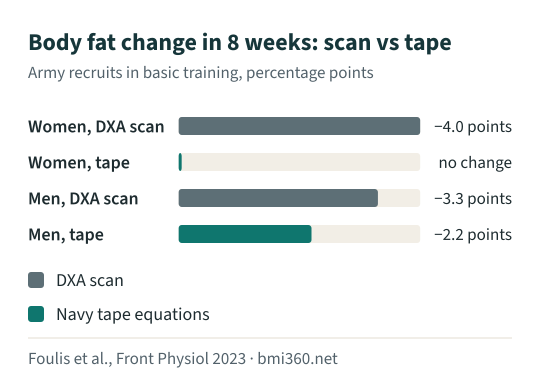
- It misses small changes: over eight weeks DXA showed body fat falling by 4.0 points in women and 3.3 points in men. The tape equations showed no change in women and 2.2 points in men.
So treat the number as a rough position, not as a reading to one percent. Two measurements a few weeks apart mostly show how consistently you held the tape.
For a screening figure with published bands, the waist-to-height ratio calculator needs only a waist and a height. The BMI calculator needs no tape at all, but it cannot tell fat from muscle.
What this body fat calculator leaves out, and why
- No "good" or "bad" ranges. Body fat charts differ from source to source, and we have not found one set of categories we can cite with confidence. The page therefore gives the estimate without grading it.
- No military pass or fail. These equations were the basis of the tape test described in Army Regulation 600-9. The Army no longer uses a body fat percentage: since July 2026 its only standard is the waist-to-height ratio.
- No advice. If you want to know your body composition for a medical reason, ask a doctor about a measured method such as DXA.
Questions about the Navy body fat formula
How can I calculate my exact body fat?
Not with a tape measure. The Navy equations have a reported standard error of 3 to 4 percentage points, and in a 2023 study of 1,407 Army recruits the tape estimate was on average 6 percentage points lower than a DXA scan, for women and men alike. For a measured figure, ask a doctor about DXA, the scan that study used for comparison.
Is 20% or 30% body fat a lot?
This calculator does not grade body fat percentages: body fat charts differ from source to source, and we have not found one set of categories we can cite with confidence. The tape estimate also reads low against a DXA scan, so the same person can get two different numbers. For a screening figure with published bands, use the waist-to-height ratio calculator.
Is 170 pounds overweight for a 5 ft 10 in man?
Not by BMI: 170 pounds at 5 ft 10 in is a BMI of 24.4, inside the healthy weight range of 129–173 lb for that height. BMI cannot tell fat from muscle, so the same weight can mean quite different amounts of body fat. The BMI calculator gives the range for any height.
Where do I measure?
Neck: around the neck. Men: around the abdomen at the level of the navel. Women: around the waist at the narrowest part of the torso, and around the hips at the widest part of the buttocks. Hold the tape flat on the skin without pulling it tight.
Why do women enter a hip measurement?
Separate equations were developed for women and men. The equation for women uses waist plus hips minus neck; the equation for men uses abdomen minus neck.
Does the Army still use this tape test?
No. Since July 2026 the Army measures only the waist-to-height ratio and no longer estimates a body fat percentage. See the Army calculator for the current standard.
Can I use it to track fat loss?
Only for large changes. In the 2023 study of Army recruits, eight weeks of basic training lowered body fat by 4.0 points in women and 3.3 points in men when measured by DXA. The tape equations showed no change in women and 2.2 points in men.
Sources
- Foulis SA, Friedl KE, et al. Body composition changes during 8 weeks of military training are not accurately captured by circumference-based assessments. Front Physiol. 2023;14:1183836 — the equations for women and men, where to measure, and how the tape estimate compares with DXA scans in 1,407 recruits (checked October 12, 2026)
- Army Directive 2026-13 (Army Body Composition Program and Standards) — signed by the Secretary of the Army on 1 July 2026, effective immediately; listed as active by the Army Publishing Directorate (checked October 12, 2026)