BMI Calculators
These BMI calculators turn height and weight into a body mass index and read it by age: against four fixed ranges for adults, and against the CDC growth charts for ages 2 to 19.
Body mass index puts weight in relation to height: weight in kilograms divided by height in metres squared. It takes a scale and a tape measure, which is why it is so widely used as a first look at weight; CDC calls it a simple, reliable and low-cost screening measure. The calculators here do that sum and then explain what the result means for the person it belongs to.
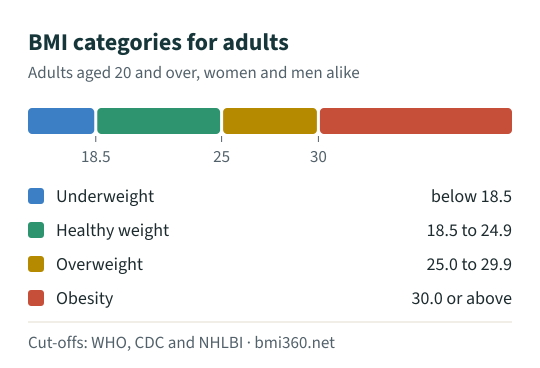
That last part depends on age. For adults aged 20 and over the BMI is read against four fixed ranges, the same for women and men: under 18.5, 18.5 to 24.9, 25.0 to 29.9 and 30.0 or above.
For children and teens aged 2 to 19 a fixed range would be wrong, because a healthy BMI changes with every year of growth. Their BMI is turned into a percentile for their age and sex using the CDC growth charts, and the category is read from the percentile.
Pick the calculator that matches who you are measuring:
- BMI calculator for adults: BMI, category, a scale with your position and the healthy weight range for your height.
- Kids BMI calculator for ages 2 to 19: the BMI-for-age percentile and the point on the growth curve.
- Reverse BMI calculator: the weight that corresponds to a BMI at your height.
BMI is a screening measure. It cannot tell muscle from fat and it does not show where fat sits, so each page also says what its result does not tell you.
For the full table of heights and weights, see the BMI chart. The waist-to-height ratio calculator adds the measurement BMI leaves out: where the weight sits.
All BMI calculators
- BMI CalculatorBMI, category and healthy weight range for adults, in pounds or kilograms.
- Kids BMI CalculatorBMI-for-age percentile for ages 2 to 19 from the CDC growth charts, shown on a growth curve.
- Reverse BMI CalculatorThe weight that matches a BMI at your height, in pounds, kilograms and stone.
Guides
Sources
- CDC: BMI frequently asked questions — the formula in metric and U.S. units, and what BMI cannot show (checked October 12, 2026)
- CDC: Adult BMI categories — category names and ranges for adults 20 and older, including obesity classes (checked October 12, 2026)
- CDC: Child and teen BMI categories — percentile categories for ages 2 through 19, including severe obesity (checked October 12, 2026)