Waist-to-Height Ratio Calculator
This waist-to-height ratio calculator divides your waist by your height and shows the band NICE assigns to the result. The short version: keep your waist below half your height.
Sources: NICE Updated
Waist-to-height ratio
0.49
Healthy central adiposity ratio 0.4 to 0.49
- Half your height33.5 in
- Your waist33 in
NICE classes a ratio of 0.4 to 0.49 as healthy central adiposity, with no increased health risk.
The numbers above are an example. Change them to see your own result.
A shared link contains the numbers entered here.
For adults. The bands apply to people with a BMI under 35. The result is a screening figure, not a diagnosis.
Waist-to-height ratio formula
Divide your waist by your height. Both must be in the same unit, inches or centimetres. The result has no unit.
waist-to-height ratio = waist ÷ height
The calculator rounds the ratio to two decimals and reads the band from the rounded number.
How to calculate your waist-to-height ratio: a worked example
This is the example NICE gives in its guideline:
- Height: 5 feet 7 inches = 67 in.
- Waist: 38 in.
- 38 ÷ 67 = 0.567, a ratio of 0.57.
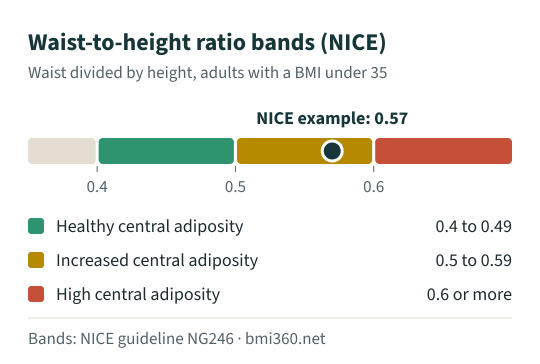
- 0.57 is in the band 0.5 to 0.59: increased central adiposity. Half of 67 inches is 33.5 inches.
In centimetres the same person measures 96.5 ÷ 170 = 0.57.
Waist-to-height ratio chart: what the NICE bands mean
| Ratio | NICE classification | What NICE says it indicates |
|---|---|---|
| 0.4 to 0.49 | Healthy central adiposity | No increased health risks |
| 0.5 to 0.59 | Increased central adiposity | Increased health risks |
| 0.6 or more | High central adiposity | Further increased health risks |
"Central adiposity" is fat carried around the middle of the body. NICE names type 2 diabetes, high blood pressure and cardiovascular disease as the health risks linked to higher levels of it. NICE gives no classification for ratios below 0.4.
NICE recommends using the ratio together with BMI for adults with a BMI under 35; the BMI calculator gives that second number. The U.S. Army uses the same ratio with a limit of 0.55 and its own rounding, and the Army body fat calculator applies those rules.
How to measure your waist
- Find the bottom of your ribs and the top of your hips.
- Wrap a tape measure around your waist midway between those two points. That is just above the belly button.
- Breathe out naturally and read the tape.
This is the method in the NICE guideline. Measure your height without shoes.
Limits of the waist-to-height ratio
- It is for adults with a BMI under 35. Above that, NICE does not use the bands.
- It is a screening figure. NICE advises people whose ratio points to an increased risk to ask a health professional for further checks. The ratio alone does not show that anything is wrong.
- A tape is not precise. Where exactly you place it and how you breathe change the reading. Measure the same way each time.
- It is not a body fat percentage. The body fat calculator estimates one from neck, waist and hip measurements, with a wide margin of error.
- Children are a separate case. NICE uses the ratio for children only from age 5 and with its own guidance.
Questions about waist-to-height ratio
What is an ideal waist-to-height ratio?
NICE, the body that writes clinical guidelines for the health service in England, gives a healthy band rather than one ideal number: a ratio of 0.4 to 0.49 is healthy central adiposity, with no increased health risk. Its plain-language advice is to keep your waist to less than half your height.
What should my waist be for my height?
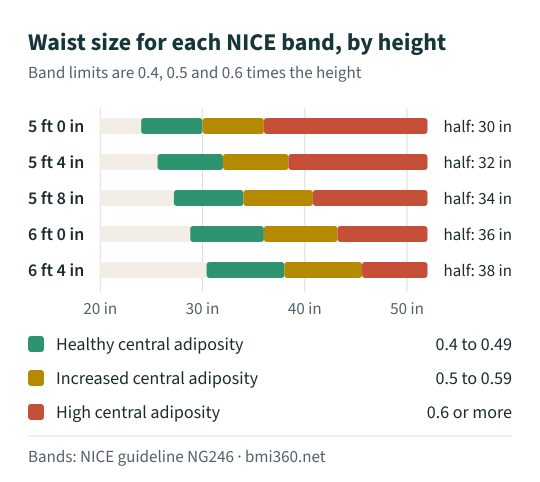
Less than half your height, which is where NICE's increased band begins. At 5 ft 7 in (67 inches) that is a waist under 33.5 inches; NICE's own example, a 38 inch waist at that height, gives a ratio of 0.57. Half your height is 30 inches at 5 ft 0 in, 32 at 5 ft 4 in, 35 at 5 ft 10 in and 36 at 6 ft 0 in, or 85 cm at 170 cm.
Where do I measure my waist?
For this ratio, NICE says to find the bottom of your ribs and the top of your hips and wrap the tape midway between them, just above the belly button, then breathe out naturally. The U.S. Army measures at the belly button itself, so its number can differ slightly.
Is the ratio different for women and men?
No. NICE states that the bands can be used for both sexes and all ethnicities, including adults with a lot of muscle. They apply to people with a BMI under 35.
Is waist-to-height ratio better than BMI?
It answers a different question. BMI relates weight to height and cannot show where fat sits. The waist-to-height ratio estimates fat around the middle. NICE recommends using both for adults with a BMI under 35.
Is this the same ratio the U.S. Army uses?
The arithmetic is the same, the rules are not. The Army's limit is 0.55, the waist is measured at the navel, and the Army rounds in its own way. Use the Army calculator for that.
Sources
- NICE guideline NG246: Identifying and assessing overweight, obesity and central adiposity — waist-to-height bands, lower BMI thresholds for some ethnic backgrounds, caution with BMI in older and muscular adults (checked October 12, 2026)
- CDC: BMI frequently asked questions — the formula in metric and U.S. units, and what BMI cannot show (checked October 12, 2026)
- Army Directive 2026-13 (Army Body Composition Program and Standards) — signed by the Secretary of the Army on 1 July 2026, effective immediately; listed as active by the Army Publishing Directorate (checked October 12, 2026)