Army Body Fat Calculator
This Army body fat calculator checks the standard in force since July 2026: a waist-to-height ratio below 0.55, which replaced the body fat tape test. Enter your height and waist to see whether you meet it.
Standard checked October 12, 2026 Sources: Army Directive 2026-13 Updated
Meets the standard
Waist-to-height ratio, as the Army records it
0.514
Standard: below 0.550 (0.549 or less)
- Height recorded70.0 in
- Waist recorded (one measurement)36.0 in
- Largest waist that meets the standard at this height38.0 in
Your recorded waist is 2 in under the limit for your height.
The numbers above are an example. Change them to see your own result.
A shared link contains the numbers entered here.
In force Army Directive 2026-13, signed July 1, 2026. Listed as active by the Army Publishing Directorate when checked on October 12, 2026.
What changed in July 2026. Army Directive 2026-13 made the waist-to-height ratio (WHtR) the only body composition standard for the Regular Army, the National Guard, the Army Reserve and cadets. The height and weight tables are gone, and so is the tape test that estimated a body fat percentage.
If another site still asks for your neck, your weight or your age group, it is using rules that were rescinded.
The Army body composition standard in 2026
- Standard: a waist-to-height ratio below 0.55. The directive's wording is "less than and not equal to 0.55".
- Same for everyone: one limit for all ages and for women and men.
- How often: at least twice per calendar year. A commander can order a measurement at any time.
- Result of 0.55 or more: a second team measures again on the same duty day. If that confirms it, the Soldier is flagged and enrolled in the Army Body Composition Program until the standard is met.
- No exemption for fitness scores: no Army Fitness Test score replaces the measurement.
WHtR = waist at the navel (in) ÷ height (in)
meets the standard when WHtR < 0.550
The general waist-to-height ratio calculator does the same division but reads it against NICE's health bands, where increased risk starts at 0.5, and measures the waist just above the navel.
How to measure waist and height the Army way
The calculator applies the rounding rules from the Army's measurement guidance (EXORD 182-26, Annex A), which decide borderline cases.
- Height. In socks, without shoes, standing straight with the head level. Rounded to the nearest half inch.
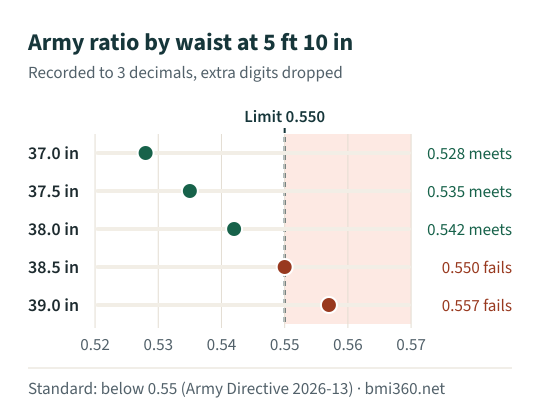
- Waist. At the navel, tape parallel to the floor, touching the skin without pressing in. Measured three times; each reading is rounded down to the nearest half inch.
- Average. The three readings are averaged. If one differs from the other two by more than 1 inch, a fourth is taken and the three closest are used.
- Ratio. Average waist divided by height, recorded to three decimals. Further digits are dropped, not rounded: 0.549888 is recorded as 0.549.
- Verdict. 0.549 or less meets the standard. 0.550 does not.
Enter one waist measurement for a quick check, or open "Add the second and third waist measurement" to average three as the Army does. Metric entries are converted to inches first.
How to calculate the Army waist-to-height ratio: a worked example
A Soldier measures 5 feet 9.3 inches without shoes. The three waist readings are 37.8, 38.2 and 38.4 inches.
- Height: 69.3 in rounds to 69.5 in.
- Waist readings rounded down: 37.5, 38, 38 in.
- Average waist: (37.5 + 38 + 38) ÷ 3 = 37.833 in.
- Ratio: 37.833 ÷ 69.5 = 0.54436, recorded as 0.544.
- 0.544 is below 0.550: meets the standard. The largest waist that passes at 69.5 in is 38.0 in.
Army maximum waist by height chart
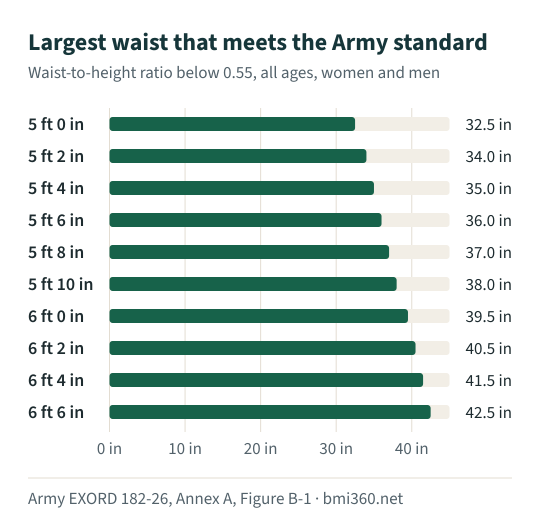
The largest recorded waist that still meets the standard at each height. The limits are the same for women and men and for every age group.
The values are copied from Annex A, Figure B-1, and checked against the rule by this site's tests.
| Height | Inches | Maximum waist (in) | Ratio at that waist |
|---|---|---|---|
| 4′ 10″ | 58.0 | 31.5 | 0.543 |
| 4′ 10.5″ | 58.5 | 32.0 | 0.547 |
| 4′ 11″ | 59.0 | 32.0 | 0.542 |
| 4′ 11.5″ | 59.5 | 32.5 | 0.546 |
| 5′ 0″ | 60.0 | 32.5 | 0.541 |
| 5′ 0.5″ | 60.5 | 33.0 | 0.545 |
| 5′ 1″ | 61.0 | 33.5 | 0.549 |
| 5′ 1.5″ | 61.5 | 33.5 | 0.544 |
| 5′ 2″ | 62.0 | 34.0 | 0.548 |
| 5′ 2.5″ | 62.5 | 34.0 | 0.544 |
| 5′ 3″ | 63.0 | 34.5 | 0.547 |
| 5′ 3.5″ | 63.5 | 34.5 | 0.543 |
| 5′ 4″ | 64.0 | 35.0 | 0.546 |
| 5′ 4.5″ | 64.5 | 35.0 | 0.542 |
| 5′ 5″ | 65.0 | 35.5 | 0.546 |
| 5′ 5.5″ | 65.5 | 36.0 | 0.549 |
| 5′ 6″ | 66.0 | 36.0 | 0.545 |
| 5′ 6.5″ | 66.5 | 36.5 | 0.548 |
| 5′ 7″ | 67.0 | 36.5 | 0.544 |
| 5′ 7.5″ | 67.5 | 37.0 | 0.548 |
| 5′ 8″ | 68.0 | 37.0 | 0.544 |
| 5′ 8.5″ | 68.5 | 37.5 | 0.547 |
| 5′ 9″ | 69.0 | 37.5 | 0.543 |
| 5′ 9.5″ | 69.5 | 38.0 | 0.546 |
| 5′ 10″ | 70.0 | 38.0 | 0.542 |
| 5′ 10.5″ | 70.5 | 38.5 | 0.546 |
| 5′ 11″ | 71.0 | 39.0 | 0.549 |
| 5′ 11.5″ | 71.5 | 39.0 | 0.545 |
| 6′ 0″ | 72.0 | 39.5 | 0.548 |
| 6′ 0.5″ | 72.5 | 39.5 | 0.544 |
| 6′ 1″ | 73.0 | 40.0 | 0.547 |
| 6′ 1.5″ | 73.5 | 40.0 | 0.544 |
| 6′ 2″ | 74.0 | 40.5 | 0.547 |
| 6′ 2.5″ | 74.5 | 40.5 | 0.543 |
| 6′ 3″ | 75.0 | 41.0 | 0.546 |
| 6′ 3.5″ | 75.5 | 41.5 | 0.549 |
| 6′ 4″ | 76.0 | 41.5 | 0.546 |
| 6′ 4.5″ | 76.5 | 42.0 | 0.549 |
| 6′ 5″ | 77.0 | 42.0 | 0.545 |
| 6′ 5.5″ | 77.5 | 42.5 | 0.548 |
| 6′ 6″ | 78.0 | 42.5 | 0.544 |
| 6′ 6.5″ | 78.5 | 43.0 | 0.547 |
| 6′ 7″ | 79.0 | 43.0 | 0.544 |
| 6′ 7.5″ | 79.5 | 43.5 | 0.547 |
| 6′ 8″ | 80.0 | 43.5 | 0.543 |
Annex A lists heights from 48 to 83.5 inches. The calculator works for any height.
What happened to the Army tape test and weight tables
- Height and weight screening tables (AR 600-9). Discontinued by AD 2026-13, paragraph 5a.
- One-site tape test: Army Body Fat Assessment, AD 2023-11 (9 June 2023). Rescinded by AD 2026-13.
- Body fat exemption for a high fitness test score: AD 2023-08 and AD 2025-17. Rescinded by AD 2026-13.
- Supplemental body fat assessments used to challenge a result. Not authorized (AD 2026-13, paragraph 5a(1)).
- DA Form 5501. Rescinded; WHtR is recorded on DA Form 5500 and in ATIS.
This is why the page no longer shows a body fat percentage or limits by age and sex: the Army does not use them any more.
The body fat calculator still shows the Navy tape equations behind the old test, as an estimate without a pass mark. The BMI calculator gives a weight-based figure, but it plays no part in the Army standard.
What happens if a Soldier is over the limit
- An official result of 0.55 or more is always measured a second time, on the same duty day, by a different team, before the commander does anything.
- If it is confirmed, the Soldier is flagged and enrolled in the ABCP. Regular Army and Active Guard Reserve Soldiers get a medical examination to rule out an underlying condition; Guard and Reserve Soldiers may request one.
- The mandatory monthly assessments and progress requirements of the old program were rescinded. A Soldier is removed from the program as soon as the standard is met.
- HQDA runs a 180-day assessment of the standard. No Soldier is separated for failing the WHtR until it is complete and further guidance is issued.
- Existing medical exemptions for pregnant and postpartum Soldiers remain in effect.
Joining the Army: the standard for applicants
The Army's recruiting site says the waist-to-height standard has replaced the height and weight requirements for people who want to enlist or commission. It also says that applicants who do not meet the physical requirements at MEPS may be eligible for the fitness track of the Future Soldier Preparatory Course. The directive itself covers Soldiers and cadets, so ask a recruiter how the measurement is taken for applicants.
What is confirmed about the Army standard and what is still open
Confirmed from the Army's own documents: the 0.55 limit, who it applies to, how height and waist are measured and rounded, how the ratio is recorded, and which older methods were rescinded.
Open points we could not settle from those documents:
- The directive orders a 180-day assessment that may change the standard, and it will be replaced once AR 600-9 is revised. No outcome had been published when this page was last checked; the assessment period ends around the turn of the year 2026/27.
- goarmy.com's recruiting chart lists a maximum waist of 33 in at 5'0" and 38.5 in at 5'10". Annex A, Figure B-1 lists 32.5 in and 38 in, because 33/60 and 38.5/70 are exactly 0.550, which does not meet a standard of "less than and not equal to 0.55". The calculator follows the directive and Annex A.
- The header of the Army's FAQ sheet calls the directive "Army Directive 2026-06". The directive itself, its Army Publishing Directorate record and the Army's policy page say 2026-13. We use 2026-13.
- Annex A states that the average is rounded to the nearest half inch only for the four-measurement case. For three measurements it says to divide the average by height. The calculator divides the plain average of the entered measurements; with one measurement entered this makes no difference.
- Annex A does not say how a height exactly between two half inches (for example 69.25 in) is rounded. The calculator rounds it up.
- For applicants, goarmy.com says the WHtR standard replaced the height and weight requirements, but the directive itself covers Soldiers and cadets. How the measurement is taken at MEPS is not described in the sources above; applicants should confirm with a recruiter.
How we calculate explains how the standard file is kept and when the build refuses an outdated rule.
This calculator is an unofficial check. Only a measurement by trained personnel, recorded on DA Form 5500, counts.
Questions about the Army standard
Does the Army still use the tape test?
No: Army Directive 2026-13, signed on July 1, 2026, rescinded the one-site tape test (the Army Body Fat Assessment of 2023) and discontinued the height and weight screening tables. A tape is still used, but only to measure the waist for the waist-to-height ratio. No other body fat method may be used to challenge the result.
What is the Army body fat standard now?
There is no body fat percentage standard any more. A Soldier meets the body composition standard with a waist-to-height ratio below 0.55. A ratio of 0.55 or more leads to a flag and enrollment in the Army Body Composition Program.
Is there a new Army height and weight chart for 2026?
No: Army Directive 2026-13 discontinued the height and weight screening tables, and weight plays no part in the standard any more. What the Army publishes instead is a chart of the largest waist that meets the standard at each height, in Annex A of its measurement guidance: at 5 ft 10 in that is 38.0 inches. This page shows it as the Army maximum waist by height chart.
Is the standard different for women, men or older Soldiers?
No. The old body fat limits depended on age and sex. The waist-to-height standard is one number, 0.55, for all Soldiers and cadets.
Is a ratio of exactly 0.55 a pass?
No: the directive says the ratio must be less than and not equal to 0.55. The Army records three decimal places and drops the rest without rounding: 0.549 meets the standard, 0.550 does not. At a height of 70 inches a 38.5 inch waist is exactly 0.550, so the largest waist that passes is 38.0 inches.
Where and how is the waist measured?
At the navel (belly button), with the tape parallel to the floor and in contact with the skin without compressing it. The waist is measured three times and each reading is rounded down to the nearest half inch. Height is measured in socks without shoes and rounded to the nearest half inch.
Does a high Army Fitness Test score exempt me?
No. The directive states that no AFT score exempts a Soldier from the waist-to-height standard, and it rescinded the earlier exemption for Soldiers who scored 465 or higher.
Sources
- Army Directive 2026-13 (Army Body Composition Program and Standards) — signed by the Secretary of the Army on 1 July 2026, effective immediately; listed as active by the Army Publishing Directorate (checked October 12, 2026)
- EXORD 182-26, Annex A: Implementing Guidance for Waist to Height Ratio Measurement Procedures for the ABCP — measurement and rounding rules, Figure B-1 (maximum waist by height), instructions for DA Form 5500 (checked October 12, 2026)
- Army Body Composition Program and Standards: FAQ (Tell Your Formation) — gives the effective date as July 7, 2026, the three-decimal rule and the end of the AFT score exemption and the tape test (checked October 12, 2026)
- Army.mil: Army modifies body composition program, adopts waist-to-height ratio (July 7, 2026) — the Army's announcement of the change (checked October 12, 2026)
- goarmy.com: Eligibility and requirements to join — says applicants must meet the WHtR standard; its chart differs from Annex A at two heights, see the open points above (checked October 12, 2026)