BMR Calculator
This BMR calculator estimates the calories your body uses in a day at complete rest, from age, sex, height and weight. It uses the Mifflin-St Jeor equation from 1990.
Sources: Mifflin et al. 1990 Updated
Resting energy expenditure
1,651 kcal per day
- In kilojoules6,908 kJ per day
- Per hour at rest69 kcal
An estimate of the energy your body uses at complete rest, from the Mifflin-St Jeor equation. It does not include movement or exercise.
The numbers above are an example. Change them to see your own result.
A shared link contains the numbers entered here.
For adults. An estimate for general information; it is not a calorie target or a diet plan.
Mifflin-St Jeor equation: how BMR is calculated
The calculator uses the Mifflin-St Jeor equation. It predicts resting energy expenditure, in kilocalories per day, from weight, height, age and sex.
men: 10 × weight (kg) + 6.25 × height (cm) − 5 × age (years) + 5
women: 10 × weight (kg) + 6.25 × height (cm) − 5 × age (years) − 161
Pounds and inches are converted to kilograms and centimetres first. One kilocalorie is 4.184 kilojoules.
How to calculate BMR: a worked example
A 35-year-old woman who is 165 cm tall and weighs 65 kg:
- 10 × 65 = 650.
- 6.25 × 165 = 1,031.25.
- 5 × 35 = 175.
- 650 + 1,031.25 − 175 − 161 = 1,345.25, or about 1,345 kcal per day.
Where the Mifflin-St Jeor equation comes from
Mifflin, St Jeor and colleagues measured the resting energy expenditure of 498 healthy adults, 247 women and 251 men aged 19 to 78, by indirect calorimetry. About half had a normal weight and half had obesity.
The equation above is the simplified form they published in the American Journal of Clinical Nutrition in 1990. In their data the older Harris-Benedict equations from 1919 overestimated measured resting energy by 5%.
What a BMR estimate leaves out
- Movement. Walking, work, exercise and even fidgeting come on top of resting energy. This calculator stops at resting energy and does not add an activity estimate.
- Body composition. In the same study, fat-free mass was the best single predictor of resting energy. The equation does not know how much of your weight is muscle. The body fat calculator gives a rough tape estimate of that split.
- Individual variation. Weight, height, age and sex explained 71% of the variation between people. Your measured value can be higher or lower than the estimate.
- Ages outside the study. The equation was derived from adults aged 19 to 78. It was not built for children or teenagers.
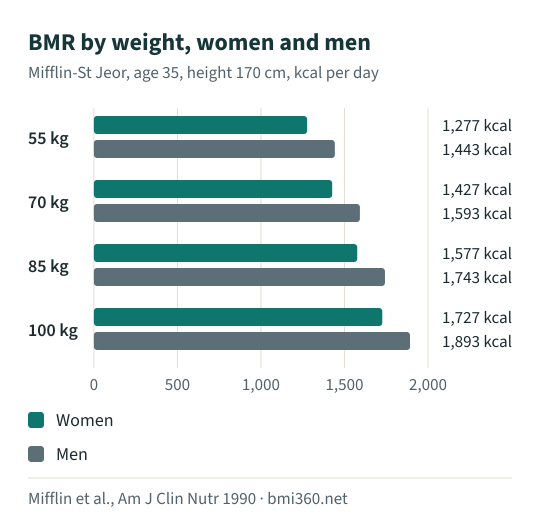
Weight enters the equation directly, so the estimate moves with it. The BMI calculator and the ideal weight calculator show how a weight compares with the healthy range for your height.
If you need a figure to act on, for example because of an illness or a pregnancy, ask a doctor or registered dietitian.
Questions about BMR
What is BMR?
Basal metabolic rate is the energy your body uses to stay alive at complete rest: breathing, circulation, keeping warm. This calculator estimates resting energy expenditure, the quantity the Mifflin-St Jeor study measured, which is what most people mean by BMR.
Which equation does this calculator use?
The Mifflin-St Jeor equation, published in 1990 from measurements of 498 healthy adults aged 19 to 78. For men: 10 × weight in kg + 6.25 × height in cm − 5 × age + 5. For women the last term is − 161 in place of + 5.
What is a typical result?
It depends on size, age and sex. The equation gives 1,743 kcal a day for a 35-year-old man of 178 cm and 80 kg, and 1,345 kcal a day for a 35-year-old woman of 165 cm and 65 kg.
Is this how many calories I should eat?
No. It is an estimate of energy use at rest. Everything you do during the day comes on top, and that part varies a lot between people. The calculator does not estimate it, and it does not give a calorie target.
How accurate is the estimate?
It is a prediction from four numbers. In the original study, weight, height, age and sex explained 71% of the differences in measured resting energy between people; the rest is individual. A laboratory measurement by indirect calorimetry is the way to get your own value.
Sources
- Mifflin MD, St Jeor ST, et al. A new predictive equation for resting energy expenditure in healthy individuals. Am J Clin Nutr. 1990;51(2):241-7 — the equation, derived from 498 healthy adults aged 19 to 78 (checked October 12, 2026)